+86 18765923485

Water-Based Paints: Enhancing Viscosity and Stability with Sodium Alginate
Water-based paints dominate the architectural coatings market, valued for their low VOC content, easy cleanup, and reduced environmental impact compared to solvent-borne systems. Behind every smooth, sag-resistant, well-leveled coat of paint lies a carefully engineered rheology system. The thickener is the unsung hero of paint formulation—it controls viscosity during storage, application, and film formation.
Conventional thickeners are predominantly non-ionic cellulose ethers, such as hydroxyethyl cellulose (HEC) and hydroxypropyl methylcellulose (HPMC). These have been extensively studied and are well understood. However, as formulators explore bio-based alternatives and seek to reduce reliance on petroleum-derived or chemically modified ingredients, sodium alginate has emerged as a candidate worth examining.
Research has directly investigated sodium alginate’s role as a thickener in typical wall paint formulations, evaluating its interaction with water, binder, pigment, and extender . This article summarizes what that research reveals and what formulators should know.-14
How Sodium Alginate Interacts with Paint Components
Unlike cellulose ethers, which are non-ionic and relatively inert in formulation, sodium alginate is an anionic polysaccharide. This introduces the possibility of interactions with other charged components in the paint—both beneficial and problematic.
Interaction with Water and Rheology
In aqueous solution, sodium alginate forms a viscous, pseudoplastic fluid. The polymer chains entangle, creating a structured network that provides viscosity at rest but thins under shear. This shear-thinning behavior is desirable in paint: it allows brushing or rolling without excessive drag, then recovers viscosity to prevent sagging after application.
Interaction with Calcium Carbonate Filler
Calcium carbonate is a common extender pigment in architectural paints. For sodium alginate, this is a double-edged sword.
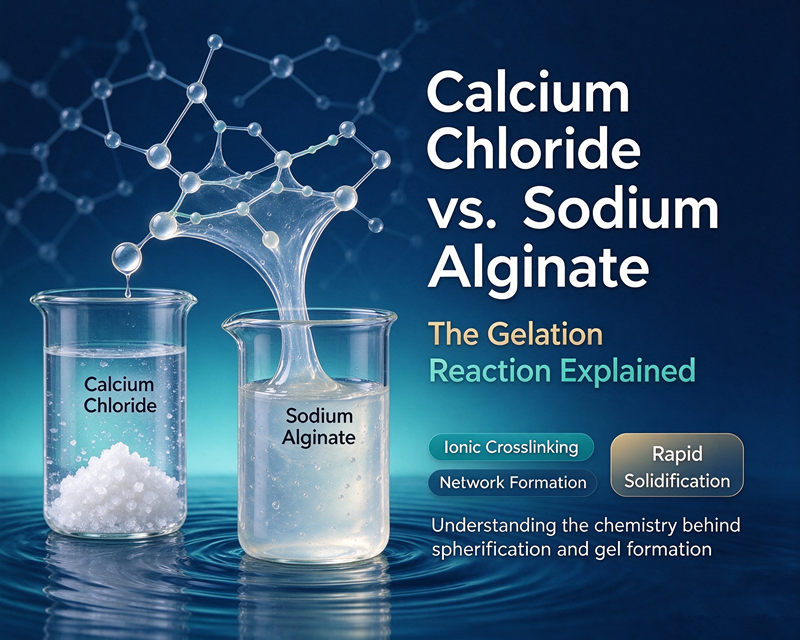
The calcium ions present at the surface of calcium carbonate particles can interact with alginate’s carboxyl groups, potentially causing ionic crosslinking. This interaction can contribute to viscosity and structure, but if uncontrolled, it can also lead to gelation, instability, or inconsistent rheology.
Research on architectural water-based coatings specifically examined this interaction using rheology and FTIR spectroscopy, confirming that sodium alginate interacts with water molecules and calcium carbonate filler . The practical implication: formulators must tune molecular weight and concentration carefully to obtain a stable, well-performing paint .-14
Interaction with Binder and Other Components
The same study evaluated interactions with the polymeric binder and other pigments. The findings indicated that while alginate’s anionic nature introduces potential compatibility issues, a properly selected grade at an appropriate dosage can function as a thickener in water-based paints. The comparison with cellulose ether benchmarks provided context for its performance envelope .-18
Advantages and Limitations
Potential Advantages
| Advantage | Relevance to Paint Formulation |
|---|---|
| Natural origin | Aligns with bio-based and eco-friendly coating trends |
| Shear-thinning rheology | Good application properties—easy brushing, sag resistance |
| Water-soluble | Simple incorporation into aqueous systems |
| Film-forming capability | May contribute to film integrity |
Limitations and Formulation Challenges
| Challenge | Explanation |
|---|---|
| Calcium sensitivity | Calcium carbonate extenders can trigger unwanted gelation; requires careful grade selection and dosage control |
| Anionic character | Potential interaction with cationic additives, pigments, or biocides |
| pH sensitivity | Viscosity may decrease at low pH as alginate converts to alginic acid |
| Mechanical robustness | Alginate gels can be weaker than synthetic alternatives; may not suit high-performance requirements |
| Limited commercial track record | Less established in coatings than cellulose ethers; formulation knowledge is less widespread |
The research literature explicitly notes that while sodium alginate has potential, its average molecular mass and concentration must be tuned to obtain a good product . It is not a drop-in replacement for HEC or HPMC—it requires formulation development.-14
Formulation Considerations
Grade Selection
For paint applications, a low to medium viscosity sodium alginate is generally more suitable than high-viscosity grades. High viscosity can make dispersion difficult and lead to overly thick, unworkable paints. The research used a low-viscosity alginate (4–12 mPa·s at 1% in water at 25°C) as one experimental material .-18
Dosage
Dosage must be optimized experimentally. Too little provides insufficient thickening; too much can cause gelation, particularly in calcium-containing formulations. A reasonable starting range is 0.2–0.8% by weight of the paint formulation, adjusted based on the alginate grade and the calcium carbonate content.
Managing Calcium Interaction
If the formulation contains calcium carbonate, consider:
Using a sequestrant (such as sodium hexametaphosphate) to buffer free calcium and prevent premature gelation
Pre-dispersing alginate in the water phase before adding calcium-containing fillers
Selecting a lower-viscosity grade to reduce sensitivity to calcium-induced crosslinking
Processing
Sodium alginate should be dispersed properly to avoid lumps—the same hydration challenge common to all hydrocolloids. Dry blending with a portion of the powdered ingredients (such as the extender or pigment) before adding to water is the most reliable approach.
Is Sodium Alginate Ready for Commercial Paint Formulation?
The honest answer: it depends on the application and performance requirements.
For interior wall paints with moderate performance demands and a formulation that accounts for alginate’s calcium sensitivity, sodium alginate can function as a bio-based thickener. The research confirms its technical feasibility .-14
For high-performance coatings—exterior paints requiring excellent weatherability, or formulations with complex additive packages—cellulose ethers remain the safer, more established choice. Alginate’s anionic character and calcium sensitivity introduce formulation risks that may not justify the switch unless bio-based content is a primary marketing requirement.
The most realistic near-term opportunity is in eco-positioned interior paints where the natural origin of alginate supports a sustainability claim, and where the formulation can be adjusted to accommodate its chemistry.
Why Choose Qingdao Lanneret Biochemical Co., Ltd.?
Qingdao Lanneret Biochemical Co., Ltd. has been manufacturing sodium alginate since 2007. We supply industrial-grade alginate suitable for coatings and other non-food applications, backed by consistent quality and full documentation.
Our Advantages for Coatings Formulators:
Multiple viscosity grades: Low-viscosity options suited to paint formulation
Industrial-grade pricing: Cost-effective for non-food applications
Consistent quality: Tight batch-to-batch control for reproducible results
Technical support: Guidance on dispersion and compatibility
Global shipping: Reliable supply to coatings manufacturers worldwide
We understand that thickener performance directly affects paint quality. Our industrial alginate is manufactured to deliver consistent rheology—batch after batch.
Conclusion
Sodium alginate is a technically viable thickener for water-based architectural paints, with research confirming its interaction with paint components and its potential as a bio-based rheology modifier . However, it is not a direct substitute for cellulose ethers. Its anionic character and calcium sensitivity require formulation development—particularly in paints containing calcium carbonate extenders.-14
For formulators pursuing bio-based coatings or seeking to diversify thickener options, sodium alginate merits evaluation. With proper grade selection and dosage optimization, it can contribute to a stable, well-performing water-based paint.
Contact Us
Interested in evaluating sodium alginate for your coatings formulation? Contact our team for samples, technical data, and pricing.
Qingdao Lanneret Biochemical Co., Ltd.
Website: www.qdalginate.com
Elaine Yu | Sales Manager
Email: [email protected]
Phone: +86 18765923485
Industrial alginate solutions for coatings—since 2007.